
The Gap in AI Ethics That We Need to Talk About
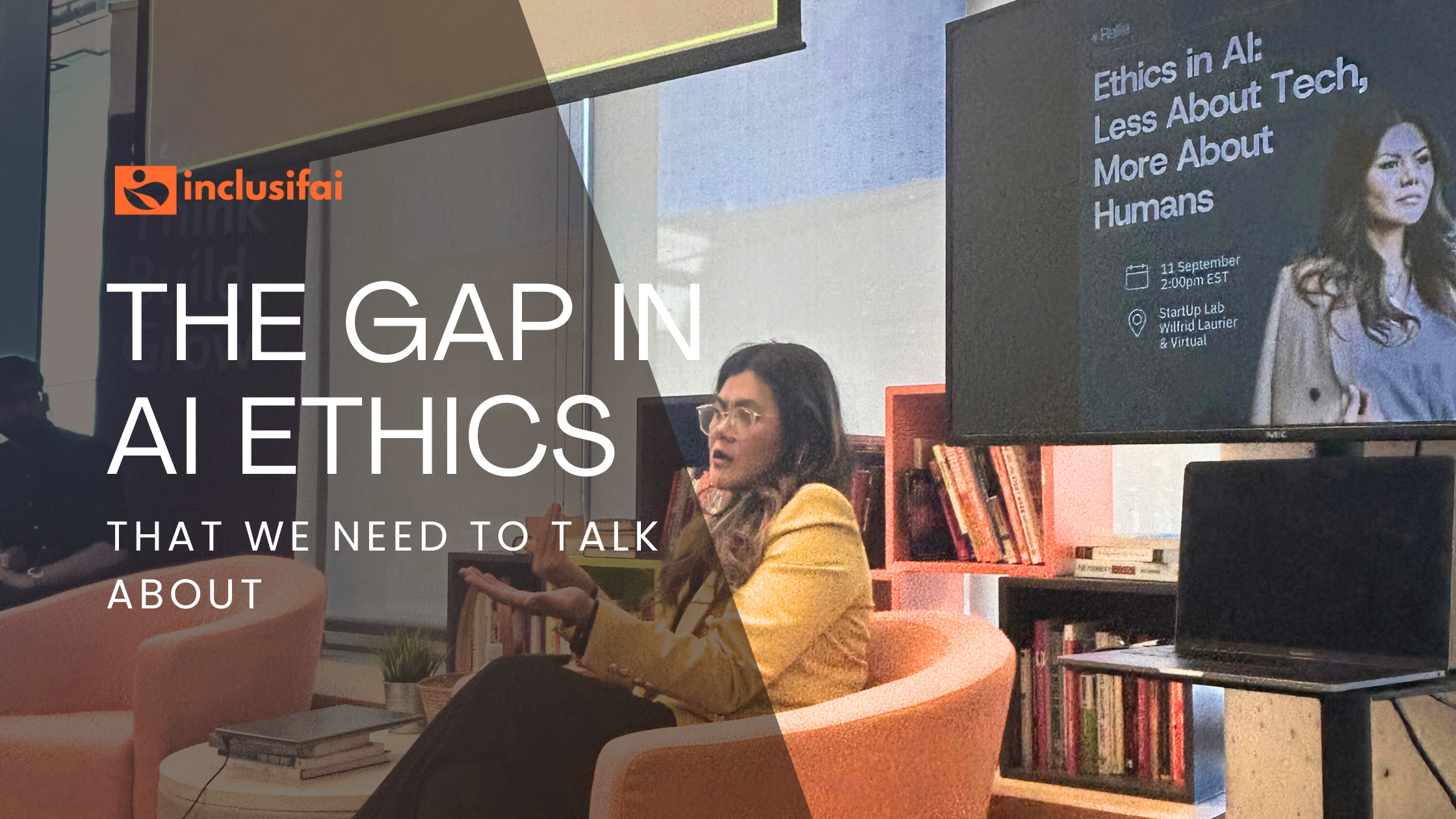
Responsible AI conversations focus on data, audits, and safeguards.
Important, but late.
The real decisions shaping AI happen earlier.
At the funding stage.
Capital decides who gets to build, which problems matter, and whose lived experience shapes design. When only a narrow segment of founders receive resources, the worldview behind AI becomes narrow too. And narrow worldviews create predictable ethical failures.
This is the part of the AI conversation that rarely makes it to the table.
Funding sets the direction long before AI exists
In Canada, women-identifying founders receive less than 4% of venture capital. Indigenous, racialized, newcomer, disabled, and LGBTQ2S+ founders face even greater barriers.
These gaps don’t just shape who builds companies.
They shape which perspectives guide AI systems used in healthcare, finance, justice, and education.
At the same time, only 12.2 percent of Canadian firms use AI tools.
The top barrier is cost and financing.
When access is limited at the start, inclusion fails everywhere else.
The missing layer in responsible AI
Most frameworks start at data or deployment.
The most important layer comes before both: capital access.
If funding pipelines overlook entire communities, the systems built downstream will reflect the same exclusions.
This is not a technical issue.
It is an architectural one.
What needs to change
• treat capital access as an ethical requirement
• broaden who gets identified as “innovators”
• embed lived experience into early design
• shorten the path to investment for overlooked founders
• build funding tools aligned with how innovation actually happens now
Responsible AI begins at the point of resourcing.
Not the point of auditing.
Why InclusifAI is building here
Founders have already changed how companies are created. Funding systems haven’t.
InclusifAI is closing that gap by building infrastructure that sees who has been overlooked and connects them to capital faster, with more transparency and more accuracy.
If we want AI that reflects society, we must change who gets the chance to shape it.
AI starts with access. Access starts with funding.
References
Women Entrepreneurship Knowledge Hub. (2024). The State of Women’s Entrepreneurship in Canada 2024.
https://wekh.ca/research/the-state-of-womens-entrepreneurship-in-canada-2024/
Statistics Canada. (2025). Analysis on Artificial Intelligence Use by Businesses in Canada.
https://www150.statcan.gc.ca/n1/pub/11-621-m/11-621-m2025008-eng.htm
Aarts, D. (2025). How Investors Can Help Close the Gender Funding Gap. Smith School of Business, Queen’s University.
https://smith.queensu.ca/insight/content/How-Investors-Can-Help-Close-the-Gender-Funding-Gap.php
